
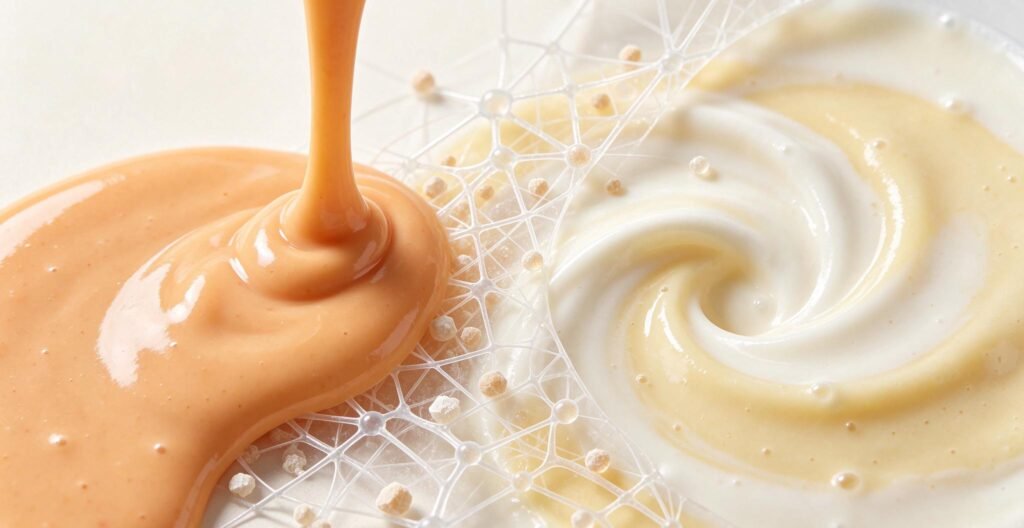
Introduction: Cross-linked starch earns its place in sauces and emulsified drinks by holding viscosity, keeping solids suspended, and staying stable while the product is pumped.
A sauce that looks even in the kettle but shows a watery ring in the jar, or a drink that separates into a pale layer near the lid, usually signals that one part of the starch system was asked to do more than it could. Thickening is the easy part to notice. Suspension and shear stability are the quiet parts that decide whether a product still looks right after filling, transport, and a few weeks on a shelf. This breakdown follows those three demands through a real sauce and beverage line, and shows where a cross-linked tapioca starch such as E1412 fits into that picture.
Why Sauces Need Both Thickening and Suspension
Thickening is the job most people already understand, because it is the one a spoon can feel. A sauce needs body so it coats food, clings to a spoon, and reads as rich rather than watery. That body comes from a starch paste built out of swollen granules: when starch is heated in water, the granules take up water, swell, and overlap into a continuous network that raises viscosity. In a ketchup, a chili glaze, or a mayonnaise-style dressing, this viscosity is what gives the product its coating behaviour and its smooth, even flow out of a bottle or a pump. Suspension is the second job, and it is the one that decides whether a sauce still looks good later. Most sauces carry things that are heavier or lighter than the surrounding liquid: tomato pulp, ground spices, herb fragments, cocoa particles, or dispersed oil droplets. If the paste loses structure, those particles drift. Solids drop into a dense layer at the bottom, oil gathers into a ring at the top, and the sauce starts to look separated even though nothing is actually spoiled. A starch paste prevents this by holding a light internal structure at rest — enough resistance to keep particles from moving, while still flowing when the bottle is squeezed or the pump pulls. These two jobs are connected but not identical, which is why simply adding more starch rarely fixes a separation problem. A very thick paste can be grainy, sticky, or too heavy to pump, and it can still thin out under acid or shear and lose suspension later. Cross-linked starch addresses this by reinforcing the granules themselves. The phosphate cross-links add bridges between starch chains, so granules swell into a firm, resilient network instead of bursting open and collapsing. A tapioca base keeps the paste clean-tasting and smooth rather than opaque or cereal-like, and a typical public specification for E1412 lists a viscosity above 700 BU with starch content at or above 85 percent — a paste built to hold structure rather than just add bulk.
How Acid and Shear Stress Change Starch Paste Behavior
A sauce line puts starch paste under two very different kinds of pressure, and both end in the same symptom: the sauce thins and stops suspending. Acid works chemically, slowly attacking the starch chains themselves. Shear works physically, tearing at swollen granules as they pass through pumps, homogenizers, and filling valves. Understanding them separately makes it easier to see why a cross-linked starch is discussed so often in sauce and beverage applications.
1. Acidic Ingredients Alter Starch Paste Stability Over Time
Many sauces are acidic by design — tomato-based products, vinegar dressings, fruit-based glazes, and anything with citrus or fermented ingredients. In that environment, starch chains gradually break down, and the paste loses viscosity not in the first minute but over hours and days. A native starch often drops quickly under these conditions, so a sauce that was glossy at filling can turn runny in storage. Cross-linking helps because the bridges between chains hold the granule framework together even as some chains are attacked, which slows the viscosity loss. E1412 is specified in the pH 5.0–7.0 range as a reference point, and the actual pH of the finished recipe is what determines how much acid exposure the paste really sees.
2. Continuous Pumping Tests Whether the System Holds Together
Physical shear is where a lot of promising lab pastes fall apart. Between the kettle and the package, a sauce passes through transfer pumps, in-line mixers, homogenizers, and filler nozzles, and every one of those steps applies force to swollen granules. Native starch granules are fragile once swollen; shear can rupture them, releasing their contents and thinning the paste permanently. Cross-linked granules are tougher, so they deform and recover instead of splitting. That is what shear stability means in practice: the paste keeps enough viscosity and enough internal structure after processing to still suspend particles and still coat food. It also has to remain pumpable, which is the balancing act — enough structure to suspend, not so much that the line struggles.
What Emulsified Drinks Need From a Thickening Starch
Emulsified drinks create a different set of demands because the dispersed phase is oil rather than solid particles. Oil droplets are lighter than the water phase around them, so they rise. If the continuous phase is too thin, they gather into a cream layer at the top, and shaking the bottle no longer brings the drink back to an even appearance. Raising the viscosity of the continuous phase slows that movement, and a light network from cross-linked starch can hold droplets in place while the drink still pours and drinks cleanly. This is where the thickening starch becomes part of the emulsion stability, not just a texture tool. Mouthfeel decides whether that structure is welcome. A beverage that carries too much of a heavy, gluey body feels wrong, no matter how stable it is, so formulators look for a starch that builds suspension with a short, clean texture rather than a long, stringy one. Tapioca-based E1412 is often discussed in this context because the base starch gives a relatively neutral taste and a clear, smooth paste, which suits dairy-style drinks, plant-based beverages, and emulsified juice products. These drinks also go through pumping, homogenization, and often heat treatment before filling, so the starch has to survive the same shear and temperature ride as a sauce. Recipe design, pH, homogenization, and sterilization conditions all shift the final result, which is why the specification is a starting reference point rather than a finished answer.
Conclusion
Sauces and emulsified drinks ask one starch to do three jobs at once: build viscosity, keep particles and oil droplets in place, and hold that structure through acid exposure and continuous pumping. Cross-linked tapioca starch such as E1412 is designed around exactly that combination, since the reinforced granule network resists both chemical breakdown and physical rupture while the tapioca base keeps the paste smooth and neutral. Anyone learning formulation can use the public specification — starch content at or above 85 percent, viscosity above 700 BU, pH 5.0–7.0, DS 0.01–0.075 — as a way to understand what the material is built to handle, then confirm real behaviour in the actual recipe.
FAQ
Q: Why do sauces need both thickening and suspension stability?
A: Thickening gives body, coating behaviour, and the texture a spoon or pump can feel. Suspension keeps pulp, spices, and oil droplets from settling or rising into visible layers. A sauce can be thick and still separate if it lacks internal structure at rest, so both properties matter, and cross-linked starch supports them together by holding a resilient granule network.
Q: How does an acidic sauce environment affect starch paste behavior?
A: Acid gradually breaks down starch chains, and the paste loses viscosity over hours and days rather than instantly. A native starch typically thins faster, while cross-linked starch keeps more of its granule framework intact because the phosphate bridges hold the structure together. The recipe’s actual pH and acid type determine how strong that effect is.
Q: What does shear stability mean for an emulsified drink?
A: It means the starch paste keeps its viscosity and structure after passing through pumps, mixers, homogenizers, and filling valves. Fragile swollen granules can rupture under that force and thin permanently, which lets oil droplets rise. A shear-stable paste still suspends the oil phase and still pours cleanly after processing.
Sources / References
Additives | Food Standards Australia New Zealand
Database – Food Safety – European Commission