
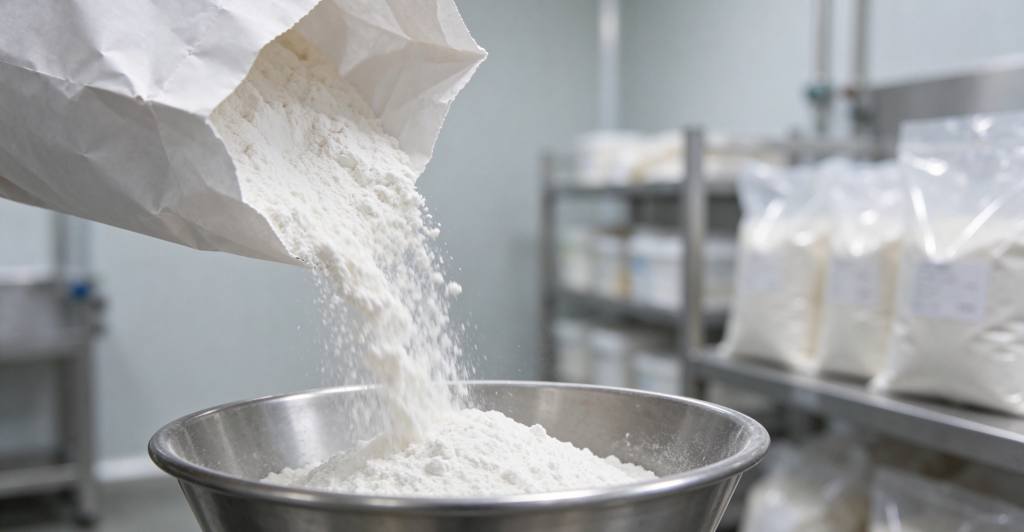
Introduction: E1412 starch keeps its dry, free-flowing, meterable character only when storage, packaging, and transfer steps protect the powder from moisture and damage.
Anyone who has opened a bag of starch at the start of a shift and found lumps instead of powder knows the problem is rarely dramatic — it just quietly slows the line down. Industrial starch powders are hygroscopic, so the plant environment, the bag itself, and the order in which stock gets used all shape whether the powder flows cleanly into a mixer. E1412 distarch phosphate is a cross-linked food starch supplied as a dry white powder for bakery, meat, dairy, sauce, and frozen food production. this guide explains the handling side of that powder: why moisture pickup matters, what different packaging formats change, and why first-in first-out is a flow decision, not just paperwork.
Moisture Pickup and Caking in Industrial Starch Powders
Starch powder is hygroscopic by nature. Each granule has a large surface area relative to its weight, and the less ordered regions inside the granule readily bond with water molecules from the surrounding air. That is why a bag left open near a wash-down area or a warm, humid corner of the plant can turn from loose powder into lumps within a shift or two. The raw-material side matters too: cassava starch is extracted from roots, then dewatered and dried into a stable powder, and that drying step sets the moisture baseline the plant then has to protect through every later handling stage. Caking is the visible end of that process. Moisture gathers on particle surfaces, neighbouring particles stick at their contact points, and those bridges harden as the surface dries again. The result is not always a solid block — often it is soft lumps that break under light pressure but refuse to flow through a feeder. In production, that shows up as bridging in hoppers, uneven screw feeding, dust surges at the filling station, and weighments that drift from target. A lump that reaches the mixer can also hydrate unevenly, leaving small dry pockets in an otherwise smooth paste. The practical point is that moisture protection is a handling habit rather than a single product feature. Sealed packaging, dry transfer routes, and short exposure windows during opening and dosing do more work than any one control. Public information on E1412 covers packaging formats and physical description but no shelf life, temperature, or humidity values, so plants set their own storage conditions from experience and internal policy.
Packaging Formats and Transfer Steps in Food Plant Handling
E1412 starch is supplied in 25 kg bags, 500 kg totes, and 1000 kg totes, and that choice changes almost everything about how the powder moves. A 25 kg bag is lifted by hand or trolley, opened at a station, and poured or scooped into a small mixer — flexible, but with many opening events and many chances for moisture exposure. A 500 kg or 1000 kg tote stays sealed longer and discharges through a single outlet, which suits continuous lines and bulk silo feeding, but it also means a single damaged tote affects far more material. Neither format is better in isolation; the right one follows the line’s dosing pattern, available lifting equipment, and how quickly the contents will be consumed.
1. Packaging Integrity Protects Powder Flow and Hygiene
A sealed bag is the powder’s only real barrier, and that barrier fails in ordinary ways: seams splitting under load, liners punctured by forklift tines, bags scuffed across pallet corners, totes stored against a damp wall. Once a pinhole opens, moisture enters slowly and locally, producing crusted patches that only appear when the bag is opened weeks later. Damage also creates a hygiene opening, which is where food safety management systems earn their keep — recognised schemes and HACCP-based plans both treat receiving inspection, pest control, and separation of damaged material as core practice rather than optional extras. A quick check of seams, liner condition, and external moisture marks at goods-in prevents most of these problems from reaching the line.
2. Transfer Steps Shape How Powder Moves Through the Plant
Every transfer point is a place where powder either stays dry or picks up moisture. An open bag tipped into a hopper exposes a large surface to room air; a screw conveyor with a partly filled flight lets fine dust settle and compact; a pneumatic line that cools below dew point can condense water on its inner wall. Practical transfer design keeps runs short, avoids unnecessary open-air drops, keeps lids and covers in place, and cleans transfer equipment between products so residues do not build up in dead zones. Operators who understand that the powder is picking up water the whole time it is exposed handle those steps more carefully than operators who see transfer as simple movement from A to B.
Why First-In First-Out Matters for Powdered Starch
First-in first-out is usually described as a stock rule, but for powdered starch it is really a moisture rule. Every bag in a warehouse sits through a slightly different history: which pallet position it landed on, how close it was to a door or a wet process area, whether it was moved twice on a forklift or left untouched for months. The oldest stock has absorbed the most of that history. Using it first means the plant consumes material while it is closest to its original dry condition, instead of discovering the accumulated effects at the bottom of a stack when nothing else is available. Rotation also exposes damage early. Bags that get moved regularly are inspected regularly, so a torn seam or a punctured liner surfaces while the pallet is still in the warehouse rather than at the mixer. Simple habits support this: date-marking on receipt, placing new deliveries behind existing stock, writing the receiving week on the pallet label, and keeping the next pallet to be used in the most accessible position. None of this requires complex systems. It requires the receiving and production teams to agree that order of use is a quality control step, not an administrative one. For anyone comparing supply options, it also helps to ask how a modified starch manufacturer packs and marks bulk deliveries, because clear pallet labelling and intact packaging make rotation easier from the first day. TAICHY Starch’s public E1412 reference lists the 25 kg, 500 kg, and 1000 kg formats described above, which gives a reasonable starting point for matching packaging to a plant’s dosing and storage layout.
Conclusion
Handling E1412 starch well comes down to three connected habits: keeping the powder dry, keeping the packaging intact, and using older stock before newer stock. Moisture pickup is a slow, cumulative process, so the plant that protects bags at goods-in, designs short and covered transfer routes, and rotates stock by receiving date will see fewer lumps, steadier feeding, and more predictable results at the mixer. None of these steps is complicated, and together they protect the dry, free-flowing, meterable powder that food production lines depend on.
FAQ
Q: Why does food-grade E1412 starch powder absorb moisture during storage?
A: Starch granules are hygroscopic, meaning their surfaces and internal amorphous regions bond readily with water vapour from the surrounding air. In storage, warm or humid conditions, opened bags, and damaged packaging all speed that uptake. The water first collects on particle surfaces and then forms bridges between particles, which is what turns a free-flowing powder into lumps and crusted patches.
Q: What do 25 kg bags and bulk totes change about handling E1412 starch?
A: A 25 kg bag is opened many times and suits small batch mixing, but each opening is a moisture exposure event. A 500 kg or 1000 kg tote stays sealed longer and discharges through one outlet, which suits continuous feeding, though damage to a single tote affects much more material. The choice should follow dosing pattern, lifting equipment, and how fast the contents will be used.
Q: Why does first-in first-out matter when handling powdered starch?
A: Because moisture exposure accumulates. Older stock has spent longer in the warehouse and has had more chances to sit near damp walls, damaged packaging, or humid air. Using it first means the plant consumes powder while it is closest to its original dry condition, and regular rotation also surfaces torn seams and punctured liners before they reach the mixer.
Sources / References
Guidebook for the Preparation of HACCP Plans – Food Safety and Inspection Service